


The short answer: AI can meaningfully cut the hours designers spend on product research, but only when it’s built on verified trade data: real pricing and lead times, and accurate specifications, not general web listings. Generic AI tools like ChatGPT can generate ideas quickly, but they often surface discontinued products or unverified pricing, which creates more work, not less. The tools worth trusting combine speed with trade-specific, continuously updated product data.
Key Takeaways
- 76% of designers believe AI will positively impact the industry, but 54% worry it could lead to homogenized, less original design work (2025 Mattoboard survey).
- 71% see AI as a creativity boost at work; 44% cite ethical concerns such as plagiarism and bias.
- The real gap between general AI and trade-specific AI is data quality: verified specs, current pricing, and real availability versus unverified web information.
Artificial intelligence is quickly becoming part of the interior design workflow. New tools help designers generate ideas, create visualizations, and streamline everyday tasks. One of the most promising use cases is AI product sourcing for interior designers, but the promise only holds up if the underlying data can be trusted.
Product sourcing is a critical part of every design project, yet it often requires hours of research, product comparisons, specification reviews, and coordination across multiple vendors and systems. As AI tools become more sophisticated, many designers are asking an important question: can AI help streamline product sourcing without sacrificing accuracy, quality, or the client experience?
That balance between opportunity and caution is already shaping how designers think about AI. According to a 2025 Mattoboard survey shared during Studio Designer’s 19 Hours Virtual Design Conference, 76% of designers believe AI will have a positive impact on the industry, while 54% worry it could lead to homogeneity and diminished originality. At the same time, 71% believe AI can boost creativity at work, and 44% cite ethical concerns such as plagiarism and bias. These findings suggest that designers are open to AI’s potential, but they want tools they can trust.
The answer depends less on the technology itself and more on the data behind it. Understanding how AI sourcing tools work, where their information comes from, and whether their recommendations can be trusted is becoming increasingly important for design professionals.
The Reality of Product Sourcing for Interior Designers
Most designers have a sourcing process that works, but it often requires moving between multiple websites, catalogs, spreadsheets, vendor portals, and inspiration platforms.
Finding the right product is only part of the process. Designers also need to verify pricing, review specifications, confirm availability, evaluate alternatives, and ensure every detail makes its way into proposals and project documentation.
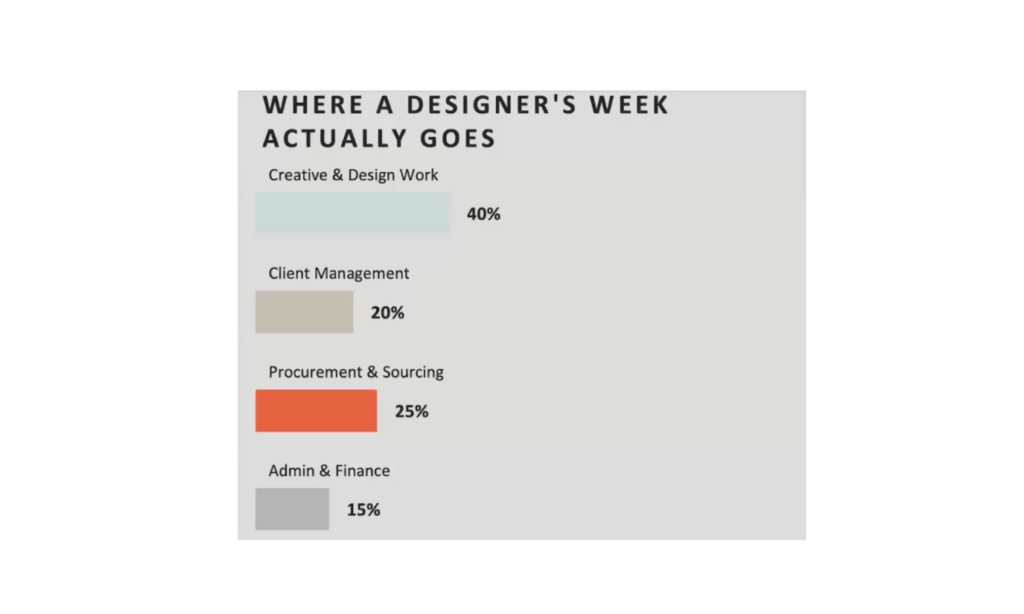
Even for experienced firms with strong vendor relationships, sourcing can represent a significant investment of time. Industry research shows that procurement-related tasks often account for a meaningful portion of a designer’s workload. Every hour spent searching for products or manually transferring information is time that cannot be spent on design development, client relationships, or business growth.
General AI vs. Trade-Specific AI: What’s the Difference?
The short answer: general-purpose AI tools are built to answer broad questions; trade-specific AI is built to support professional procurement, which requires a different data foundation entirely.
| General AI Tools | Trade-Specific AI (e.g., Studio Designer) | |
| Data source | Public web listings, indexed pages | Verified trade brand catalogs |
| Pricing | Often consumer pricing, unverified | Trade pricing, verified |
| Product availability | May include discontinued items | Reflects real, orderable inventory |
| Specifications | Can be incomplete or inaccurate | Sourced from manufacturer/trade data |
| Workflow integration | Standalone, requires manual transfer | Connected to project and procurement systems |
Generic AI can be useful for early-stage inspiration: generating ideas or exploring a style direction. But when the output needs to become a real client proposal or purchase order, unverified data creates more re-work than it saves.
How AI Product Sourcing Can Help Designers Scale Trust
Many designers have experimented with general AI tools to support research and sourcing. These tools can be useful for generating ideas, but product sourcing requires something more: trust.
Designers often discover products through showrooms, trade events, favorite brands, and vendor relationships because they trust the people and information behind them. The challenge is scale. Searching beyond those trusted sources can quickly become time-consuming and difficult to manage.
AI product sourcing has the potential to expand that reach. Instead of searching multiple websites, designers can describe what they’re looking for, search with an image, and review relevant options from a larger pool of products.
But speed alone isn’t enough. A sourcing recommendation is only as valuable as the data behind it. Product specifications, pricing, lead times, and availability all influence purchasing decisions and client expectations. If that information can’t be trusted, the recommendation has little value.
The most effective AI tools help designers scale trusted sourcing practices by combining efficiency with reliable, trade-focused product data.
Why Interior Design Procurement Requires Specialized AI
Many AI tools are designed to answer general questions, not support professional sourcing and procurement. Generic AI can surface discontinued products, inaccurate specifications, or consumer pricing that still requires verification.
For interior designers, effective AI product sourcing depends on access to verified trade data, including real product specifications, pricing, lead times, availability, and products that can actually be specified and ordered.
Building a More Connected Sourcing Process
At Studio Designer, we’ve seen how much time firms spend searching for products, verifying specifications, organizing selections, and moving information between systems. That’s why we’ve focused on helping designers streamline product sourcing through connected workflows and trade-focused product data.
To simplify that process, Studio Designer has expanded its sourcing capabilities with access to hundreds of trusted trade brands and hundreds of thousands of products in one place. Designers can search using natural language, find similar products from inspiration images, build design boards, and move approved selections directly into their project workflow.
Because sourcing is connected to the broader Studio Designer platform, product information stays with the item throughout the design and procurement process. That means fewer manual steps, less duplicate data entry, and greater confidence in the information being shared with clients and vendors.
Karie Kelly, Chief Product Officer at Studio Designer, shared during her 19 Hours session:
“Every tool that you bring into your workflow should be held to the same standard. You should trust the results that those tools are performing for you. If you can’t trust it, it really doesn’t matter how quickly you get there.”
That principle continues to guide Studio Designer’s approach to sourcing and AI: helping designers work more efficiently with trusted product data and connected workflows.
FAQ: What Designers Ask Before Adopting AI Sourcing
Where does the product data come from? Trade-specific sourcing tools pull from verified trade brand catalogs rather than public web listings, which reduces the risk of surfacing discontinued items, inaccurate specs, or consumer-only pricing.
How often is the information updated? Reliable AI sourcing tools maintain ongoing relationships with trade brands so that pricing, availability, and specifications reflect current data rather than a one-time web crawl.
Can pricing and specifications be verified? Yes, when the tool is connected to trade brand data directly. This is the core distinction between general AI search and trade-specific sourcing — verification happens at the data layer, not after the fact.
Does the tool support existing workflows? The most useful sourcing tools connect directly to a firm’s existing project and procurement systems, so approved selections move into proposals and documentation without manual re-entry.
Will it reduce manual work without creating new risks? It can, provided the underlying data is verified and current. AI sourcing that isn’t built on trade-verified data can shift time from searching to correcting errors instead, which erases the time savings.
What’s the actual difference between general AI and a trade-specific sourcing tool? General AI tools are optimized to answer broad questions using public web data. Trade-specific tools like Studio Designer are built specifically for procurement, using verified trade catalogs so that what’s recommended can actually be specified and ordered.
Can AI sourcing tools accidentally recommend discontinued or out-of-trade products? This is a known risk with general AI tools that rely on indexed web pages, which aren’t always current. Trade-specific tools reduce this risk by drawing on maintained brand relationships rather than static web data.
As AI product sourcing continues to evolve, the most valuable tools will be the ones that help interior designers make faster decisions without compromising accuracy. Technology can accelerate research and product discovery, but trusted data, industry context, and professional judgment remain essential to every successful project.
If you are evaluating payroll options or looking to simplify your current process, it may be worth reviewing how an integrated approach would work for your firm.
Schedule a demo or connect with your Studio Designer representative to learn more: https://www.studiodesigner.com/get-a-demo/
We can’t wait to connect.