


TL;DR: Interior design projects rarely fail at kickoff. They break down mid-project because manual payment tracking, scattered email communication, and disconnected accounting systems can’t keep up with growing complexity — not always because of poor design work or difficult clients. Studio Designer serves as the system of record for more than 20,000 interior design professionals, connecting projects, payments, accounting, and client communication so firms can build project-level payment systems, centralize client communication, and use traceable payment methods from day one.
Key Takeaways:
- Manual payment tracking works fine early in a project but breaks down once invoices, retainers, and reimbursements multiply.
- Email-based communication becomes unreliable once scope or pricing changes mid-project.
- Manual payment methods, like checks and shared ACH logins, introduce risk and slow down cash flow.
- Financial ambiguity creates avoidable stress for principals and studio managers.
- Systems built for the full project lifecycle, not just the start, prevent all four breakdowns.
Interior design projects rarely fail at the start. More often, they unravel halfway through, after retainers are paid, timelines are underway, and expectations feel set.
At kickoff, everything looks workable. Your systems feel sufficient, and communication feels clear. But as projects grow more complex, optimism can give way to operational strain. Payment questions take longer to answer. Email threads become harder to follow. Accounting data starts to require cleanup instead of providing clarity.
These breakdowns rarely come down to poor design work or “difficult” clients alone. They’re usually the result of systems that were never designed to support the full lifecycle of an interior design project.
This article looks at the real reasons interior design projects break down mid-way, and what firms can put in place to prevent it without adding unnecessary administrative burden.
ALSO DOWNLOAD: 5 Signs Your Design Firm Needs an Organizational Makeover
Why payment tracking breaks down mid-project
Direct answer: Payment tracking breaks down mid-project because manual systems that work fine with one invoice and one retainer can’t scale to the dozens of overlapping financial events — partial payments, reimbursements, scope changes — that accumulate as a project matures.
At the beginning of a project, systems are under very little pressure. There may be one retainer, one invoice, and a small group of decision-makers. Manual tracking feels manageable. Email feels sufficient. Spreadsheets feel organized enough.
As the project progresses, complexity increases:
- Multiple invoices and partial payments
- Retainers (upfront deposits applied against future invoices) applied over time
- Reimbursements and pass-through expenses
- Scope changes that affect pricing and timelines
- More stakeholders on the client side
These changes don’t create new problems. They expose the limits of systems that were never designed to handle them. Interior design payment workflows are inherently complex.
Firms often juggle retainers, milestone billing, partial payments, and reimbursements at the same time.
When this information is tracked manually or spread across disconnected tools, issues begin to surface. Payments get applied inconsistently, retainers aren’t always reduced correctly, and reimbursable expenses can blur into fee revenue. Over time, it becomes harder to say with confidence what a client has actually paid.
The fix: build systems that track payments at the project level from day one
Design for how projects actually unfold. The fix isn’t to “tighten up” later. Instead, choose systems that assume complexity from the start. In practice, that means assuming a single project will generate dozens of financial events over its life, many of them overlapping or arriving out of order. It also means assuming that more than one person will need to understand the financial picture without relying on someone else’s memory.
Why spreadsheets break under real project complexity. Spreadsheets depend on manual upkeep and personal context. Every invoice, payment, or adjustment requires someone to remember where it belongs, how it should be labeled, and how it affects everything else.
Six months into a project, that context is often gone. A payment comes in, and no one is sure which invoice it was meant to cover. A retainer balance looks wrong, but it’s unclear whether the issue is a mistake or a past decision that was never documented. Time is spent double-checking work that should already be reliable.
ALSO READ: “Should I Still Be Using Spreadsheets?” – Rethinking Budgeting for Interior Design Projects
What changes with project-level systems. Systems designed for design workflows handle this differently. Payments are tied directly to projects and invoices. Retainers are applied according to defined rules. Reimbursements remain distinct from fee revenue.
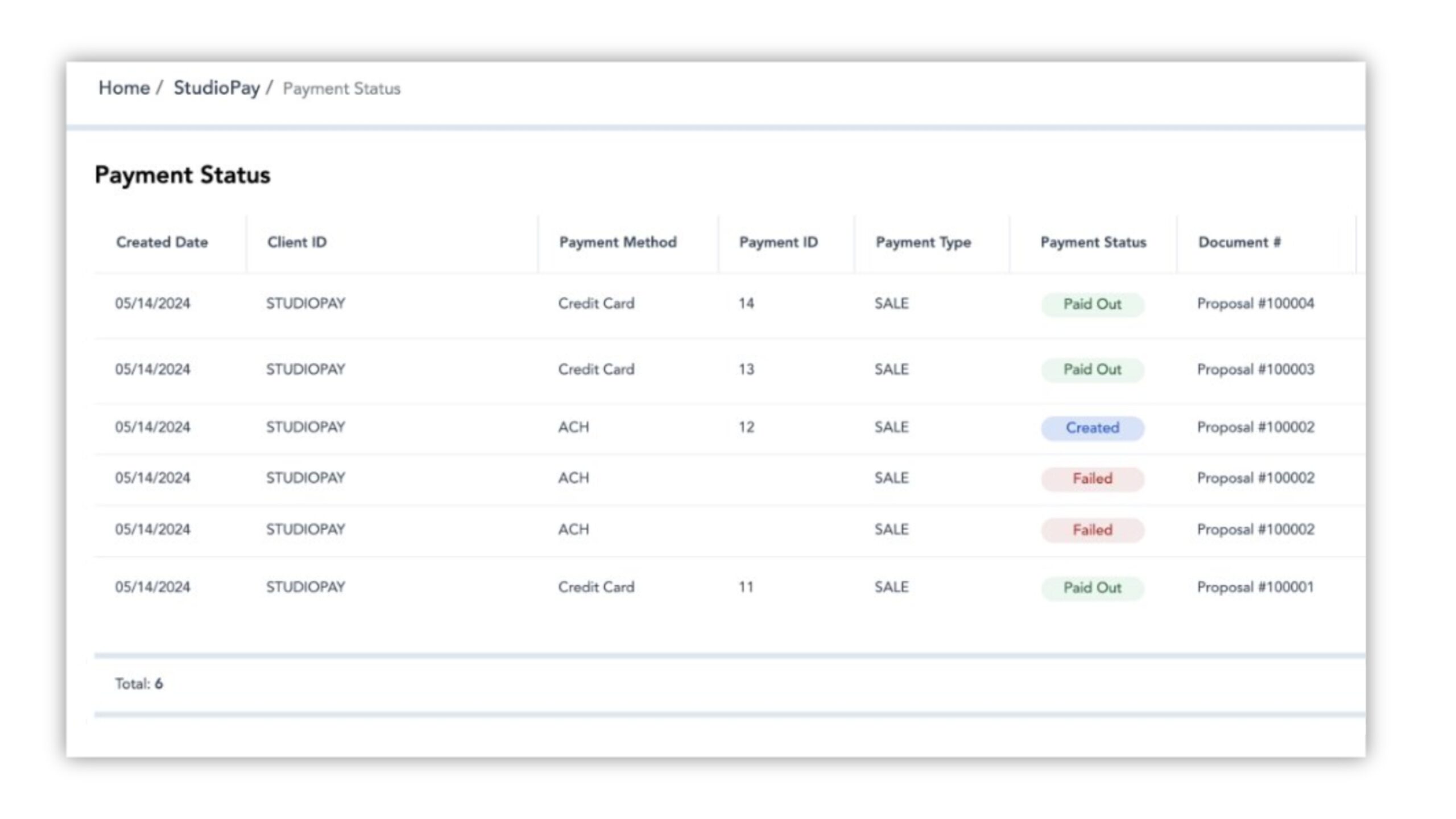
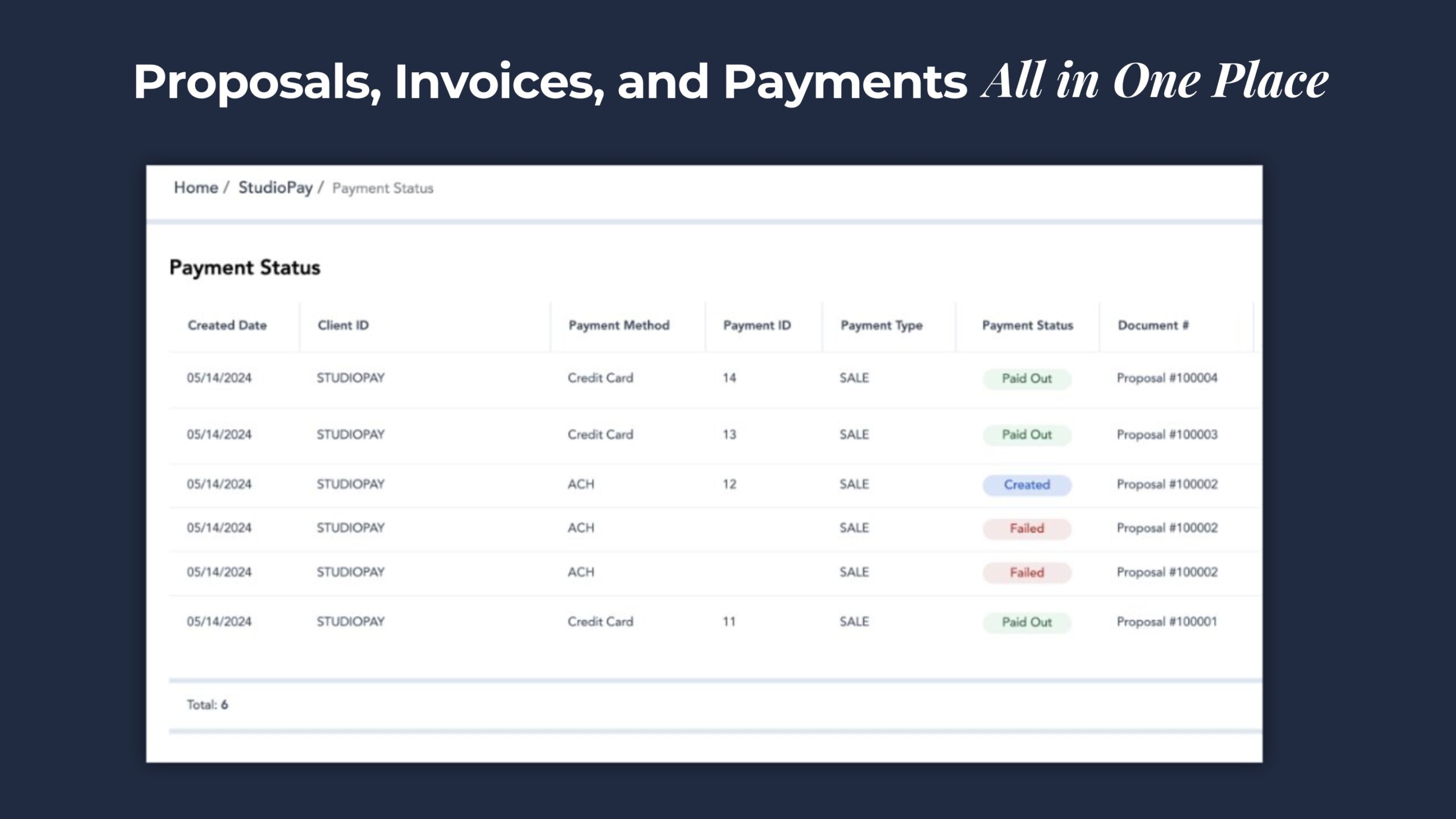
As volume increases, accuracy doesn’t depend on vigilance or memory. It’s built into the structure of the workflow. As payments move through StudioPay, they go through a few clear status stages, so firms can track payments with total transparency.
Why poor client communication amplifies financial issues
Direct answer: Client communication amplifies financial issues because email becomes unreliable once scope or pricing changes — long threads and multiple participants make it hard to answer basic questions like which invoice is current or what’s still outstanding.
Email works well early in a project. It becomes fragile once scope, pricing, or timelines change.
Long threads, forwarded messages, and multiple participants make it difficult to answer basic questions:
- Which invoice is current?
- What has been approved?
- What is still outstanding?
When designers are unsure about payment status, follow-ups become emotionally charged. Clients may feel surprised by reminders they didn’t expect. Studios may pause work while confirming balances.
The fix: centralize communication around shared, authoritative information
Centralized client access to invoices, approvals, and payment status reduces uncertainty on both sides. Instead of searching through email history or relying on verbal confirmation, designers and clients reference the same up-to-date information.
A client portal creates one place where financial context lives. Current invoices, payment history, approvals, and outstanding balances are visible without additional explanation. This reduces back-and-forth and removes guesswork from routine conversations.
When clients can see what has been issued, what has been paid, and what remains outstanding, reminders feel expected rather than confrontational. Designers no longer need to translate internal records into emails, and clients are less likely to feel caught off guard.
Follow-ups become simpler and more neutral. Conversations focus on next steps instead of clarifying the past.
ALSO READ: How Interior Designers Can Simplify the Payment Process for Clients
Support continuity as projects evolve. As projects stretch over months and involve multiple people, email threads lose context. A shared record preserves financial clarity even as team members change or conversations move on.
Over time, this visibility changes the tone of communication. Work continues without unnecessary pauses. Trust is supported by consistent access to accurate information.
Why manual payment handling introduces risk and delays cash flow
Direct answer: Manual payment handling — checks, shared ACH logins, and informal workarounds — increases exposure to error and fraud, weakens traceability, and slows the path from invoice to usable cash, which compounds into real procurement delays as projects grow.
Checks, shared ACH (Automated Clearing House, the bank network used for electronic transfers) logins, and informal workarounds increase exposure to error and fraud. Manual handling also weakens traceability and auditability.
These methods slow the path from invoice to usable cash. Checks take time to arrive and clear. ACH workarounds require follow-up. Payments disconnected from project records must be identified and reconciled before teams can move forward with confidence.
As projects grow, small delays compound. A payment may be sent but not yet visible. An invoice may be paid but not reflected where the team expects to see it.
In design work, uncertainty affects real decisions. Studios delay placing custom furniture orders with long lead times. Principals pause fabrication approvals while confirming retainer balances. Procurement slows because once an order is placed, the cash commitment is final.
Different payment methods carry different risk and timing profiles:
Payment Method | Time to Process | Risk Profile |
| Checks | Slow | High |
| ACH workarounds | Medium | Medium to High |
| General online payments | Medium | Medium |
| Purpose-built design payments | Fast | Lower |
The fix: use payment methods designed for traceability and control
Shorten the distance between invoice and confirmation. Payment tools like StudioPay, designed specifically for interior design workflows, reduce both risk and delay. Payments are linked directly to the project and invoice, recorded automatically, and visible as soon as they’re received. There’s less waiting and less interpretation required to understand what’s been paid, what remains outstanding, and what work can proceed.
Support confident, timely decisions. When payment status is clear, studios can move forward without hesitation. Custom furniture orders are released on schedule. Fabrication deposits are paid on time. Long-lead items are approved without pausing to reconfirm balances.
Cash flow becomes easier to predict, even on complex projects with staggered billing and procurement timelines. Teams spend less time tracking money and more time managing design and delivery.
For accounting professionals, cleaner and faster payment data reduces exceptions and manual investigation. For clients, clear and familiar payment experiences make it easier to pay promptly.
Over time, consistent payment workflows support healthier cash flow and reduce the operational drag that comes from waiting on money that should already be accounted for.
ALSO READ: A Fresh Look at StudioPay: Payments for Interior Designers
Why financial ambiguity creates emotional friction
Direct answer: Financial ambiguity creates emotional friction because incomplete or inconsistent data forces principals to interpret partial information and manage sensitive conversations that should be routine, turning procedural payment discussions into personal ones.
When financial information is incomplete or inconsistent, principals and studio managers carry the weight of it. They spend time interpreting partial data, qualifying their language, and managing conversations that feel more sensitive than they need to be.
Instead of focusing on design leadership or client relationships, energy is spent confirming balances, revisiting past decisions, and choosing words carefully. Over the course of a long project, this becomes a steady source of friction that is easy to normalize and difficult to measure.
Ambiguity also weakens boundaries. When teams aren’t fully confident in the underlying numbers, payment conversations feel personal rather than procedural, and clients may sense hesitation where there should be certainty. A single unexplained discrepancy on a retainer balance, for example, can turn a routine invoice follow-up into a defensive back-and-forth that has nothing to do with the design work itself.
The fix: improve transparency without adding administrative burden
Ground communication in reliable accounting. The foundation for transparency is sound accounting. When accounting functions as the system of record throughout a project, not just at reconciliation, financial conversations rest on shared, defensible information.
Accurate project-level data reduces the need for interpretation. Studio leaders reference what is already established instead of re-explaining or re-negotiating it.
Reduce emotional load by removing uncertainty. When financial information is dependable, follow-ups become routine rather than delicate. Conversations shift from managing tone to confirming next steps, which allows teams to maintain momentum without carrying unnecessary emotional weight.
This change is subtle but meaningful. It restores time and attention to design work while reinforcing professional boundaries around money.
Let structure do the work. Well-structured systems reduce administrative effort by preventing confusion instead of managing it after the fact. Fewer messages are needed to resolve questions. Fewer conversations stall because someone is unsure whether the data can be trusted.
For clients, this consistency builds confidence. For studios, it creates space to operate without hesitation. Over time, dependable financial structure supports both healthier cash flow and healthier working relationships.
FAQ
Why do interior design projects break down mid-project instead of at the start?
Because early-stage systems (one invoice, one retainer, informal tracking) work fine under low complexity, but they don’t scale as invoices, retainers, reimbursements, and stakeholders multiply over the project’s life.
What is StudioPay?
StudioPay is Studio Designer’s payment tool built for interior design workflows. It links payments directly to projects and invoices, records them automatically, and makes payment status visible as soon as funds are received.
What’s the safest payment method for interior design firms?
Purpose-built design payment tools carry the lowest risk and fastest processing time, compared to checks (slow, high risk) or shared ACH login workarounds (medium speed, medium-to-high risk).
What’s the difference between a retainer and a milestone payment?
A retainer is an upfront deposit applied against future invoices as work is completed, while a milestone payment is billed only once a specific project phase or deliverable is reached.
How can a firm move off spreadsheets without disrupting active projects?
Start by tracking new financial events (invoices, payments, retainer draws) in a project-level system going forward, while keeping historical spreadsheet data as a reference until the current project cycle closes.
What should a client portal for interior designers include?
At minimum, current invoices, full payment history, approval status, and outstanding balances, all visible without the client needing to ask.
Conclusion
Interior design projects rarely break down because designers lack skill or care. They break down when systems are pushed beyond what they were designed to handle.
As projects grow in value and complexity, scalable payment workflows, reliable accounting data, and centralized client communication stop being only operational preferences and become structural requirements. Putting these systems in place before a project begins reduces risk, protects client relationships, and helps firms maintain momentum through long timelines, scope changes, and multiple stakeholders.
This is the foundation Studio Designer was built on. For more than 20,000 interior design professionals, the platform serves as the system of record that connects projects, payments, accounting, and client communication in one place. By keeping projects, payments, accounting, and client communication connected as work progresses, Studio Designer helps firms spend less time managing friction and more time delivering great work.
Studio Designer is the leading digital platform for interior designers managing and growing their design businesses, featuring fully integrated project management, time billing, product sourcing, and accounting solutions.
Want to learn how Studio Designer can work for your design firm? Schedule a call with our team: https://www.studiodesigner.com/get-a-demo/
We can’t wait to connect.